Turn Your Website Into a Sales Engine, Not an Online Brochure

Giattech
Web Application Studio
How to make a website generate leads: message structure, CTA placement, service pages, social proof, and the conversion rates worth benchmarking against.
Table of Contents
Most business websites work like brochures: attractive, informative, and producing nothing. The difference between those and the ones that actually earn isn’t design — it’s three things: a clear message, an obvious path to action, and proof someone believes.
This article covers how to fix all three without rebuilding from scratch.
Problem one: the message is about you, not the reader
Open your homepage and read the largest sentence on screen. If it says something like “We are a trusted company since 2015 committed to delivering the best solutions”, your visitor has learned nothing.
An opening line that works answers three questions in one breath:
- What do you do?
- Who is it for?
- What do I get?
Compare:
❌ “Integrated digital solutions for the future of your business”
✅ “A reservation system for Bali resorts — guests book themselves and your team stops answering WhatsApp one message at a time”
The second one narrows the market, and that’s exactly why it works. A resort owner immediately knows it’s for them.
Problem two: there’s no path to action
An interested visitor needs to know the next step, and that step has to stay within reach.
CTA placement rules
- One primary CTA on the first screen, above the fold.
- One CTA after each complete argument — after services, after portfolio, after testimonials.
- One closing CTA at the bottom of the page.
- One persistent mobile button (WhatsApp or phone) that’s always visible.
The CTA should name the outcome
“Send” tells you nothing. “Submit” is worse.
Better: “Request a Quote”, “Book a 30-Minute Call”, “Check Date Availability”. The visitor knows exactly what happens after the click.
Reduce friction in the form
Every extra field lowers completion. For a first-contact form, three fields is plenty: name, contact, and what they need. Everything else can be asked once a conversation is running.
In the Indonesian market, a direct WhatsApp link almost always outperforms an email form. Offer both, but make WhatsApp the prominent one.
Problem three: there’s no proof
Claims without proof get ignored. Here’s the strength ladder, weakest to strongest:
- Your own claim (“we’re professional”)
- Client logos
- Testimonials with full names and photos
- Case studies with context and outcome
- Specific, verifiable numbers
What works: “Booking confirmation time dropped from an average of 4 hours to 6 minutes” is dramatically stronger than “improved operational efficiency”.
If you don’t have numbers yet, start collecting them now. Ask past clients three months after delivery — that’s usually when the data exists.
Service pages: the SEO engine everyone ignores
A single “Services” page listing six services rarely wins in search. Six separate pages, each focused on one service, is far stronger.
Each service page should carry:
- A title containing the phrase people actually search for
- The problem it solves, written in the customer’s language
- How you work, in 3–5 steps
- A price range, or at minimum how pricing is determined
- Two or three relevant examples of the work
- A short FAQ
- One clear CTA
This also strengthens your internal linking: every blog article can point at a relevant service page, and vice versa.
Pricing: don’t hide it completely
Hiding pricing entirely does filter visitors — in the wrong direction. It filters out serious buyers who don’t want to waste time, while the people who do contact you are hunting for the cheapest quote.
If you can’t publish a fixed price, publish:
- A starting point: “Projects start from IDR 15 million”
- Ranges by project type
- Which factors move the number
We cover the market figures in how much a website costs.
Conversion rates worth benchmarking against
So you have a reference point:
- 1–3% of visitors becoming leads — normal for a service business
- 3–5% — good
- above 5% — usually means highly targeted traffic
If you’re under 1%, it’s almost always one of the three problems above — not a traffic shortage.
How to measure without complicated tooling
You don’t need expensive software to start:
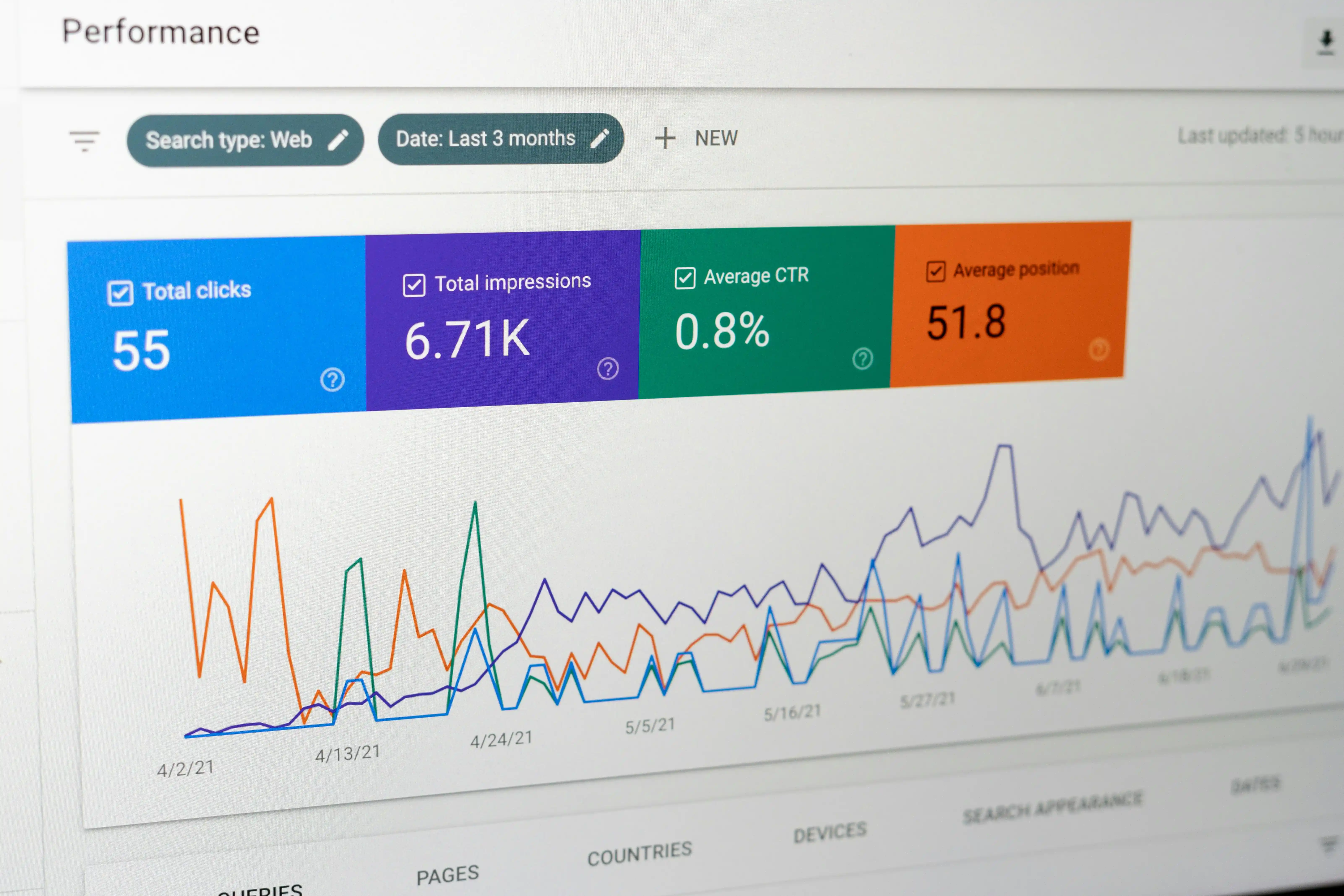
- Google Search Console — which queries bring people to you.
- Google Analytics — which pages get seen, and where people leave.
- One question on the form: “How did you hear about us?” The answers often beat any dashboard.
- Log leads manually in a spreadsheet for the first three months. The pattern shows up.
The fix order that pays off fastest
- Rewrite the homepage opening line — one hour of work, biggest impact.
- Add a persistent WhatsApp CTA on mobile.
- Cut the contact form to three fields.
- Add three testimonials with real names and photos.
- Split the services page into one page per service.
- Publish price ranges.
- Start publishing articles that answer prospect questions.
Steps one through four can be done in a day and are usually felt immediately.
Closing
A website that earns isn’t the prettiest one — it’s the clearest one. Clarity of message, clarity of next step, and proof that holds up.
If you’d like us to look at your site and name the three things holding conversion back, send us the link. To see the approach on a real project, read the Bintan Prestige case study.
NEED A HAND?
Have a project you want built properly?
Giattech builds web applications, admin dashboards, and high-performance sites for businesses in Indonesia and beyond. Tell us what you need — you get a plan back, not a brochure.